
⚽Trust the Process
Why you build a team step by step, what coaches can learn from Mikel Arteta's five-phase plan, and what a concrete training plan around it actually looks like.

Hallo und herzlich willkommen zur neuesten Ausgabe unseres Newsletters! In dieser Ausgabe stehen folgende Themen im Fokus:
⚽Patience & Development
👉New Module - Playing Principles
⚽Patience & Development
When Mikel Arteta took over at Arsenal in December 2019, the club sat tenth in the table, had crashed out of European competition, and had lost its identity. What Arteta presented to the owners wasn’t a promise of quick results. It was a plan with five clearly defined phases.
What’s fascinating is that Arteta knew from day one where the squad stood, what was needed, and above all, that it would take time. He had the development steps mapped out long before they became visible to the outside world. In this issue we look at why development happens in phases, in what order you build a team, and, concretely, what a yearly and weekly training plan around that idea looks like.
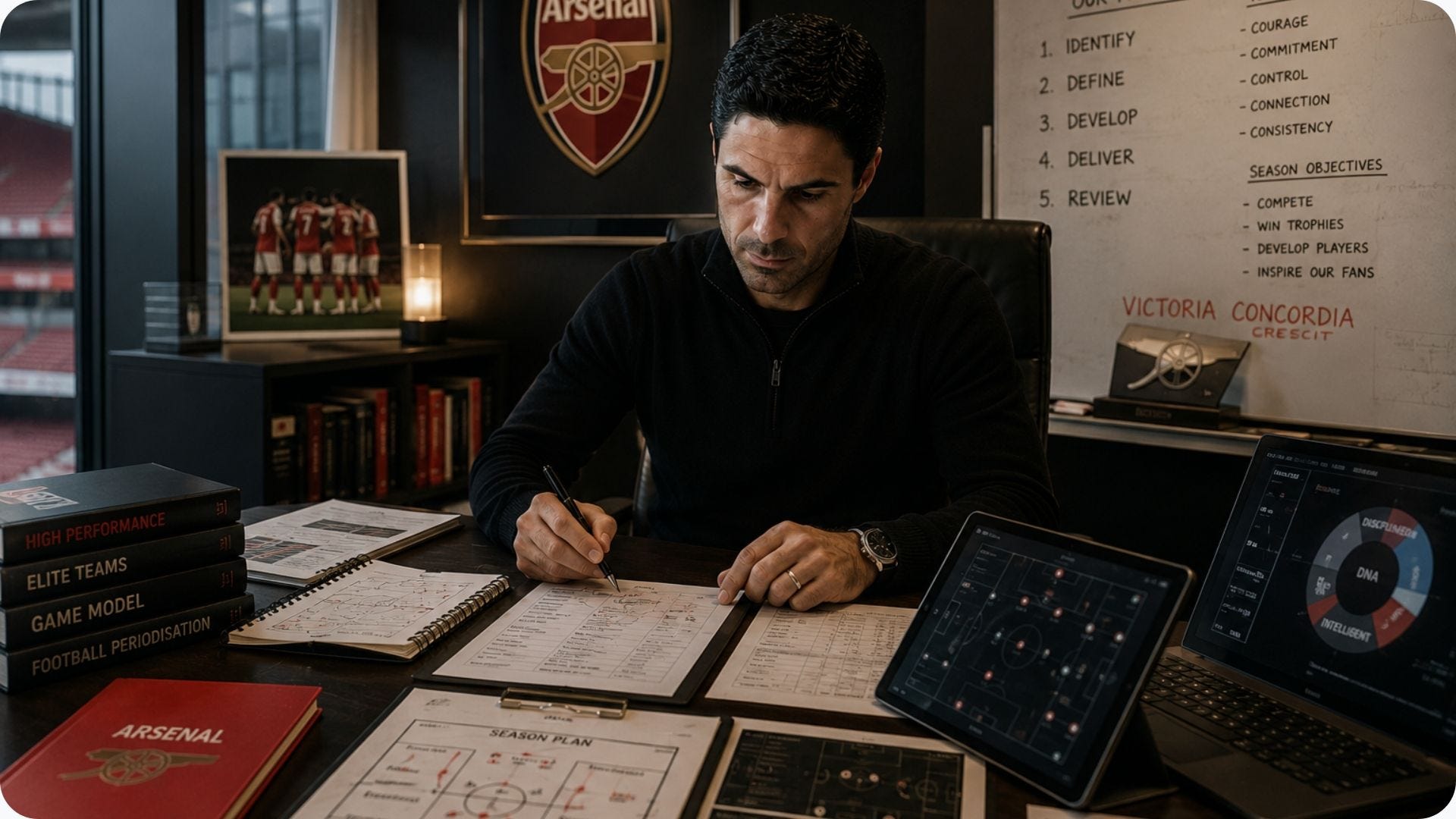
It’s just my understanding and vision of what the club was and what we have to develop. I like to do it looking forward first, and then you have to do it backwards.
Mikel Arteta · on his plan, ESPN 2023
The Arteta Plan: One Step at a Time
Arteta’s plan is a masterclass in patience. He didn’t start with tactics. He started with culture. The first phase revolved around what he called the “non-negotiables”, the standards he refused to compromise on: full commitment, professional behaviour, maximum energy. Players who didn’t buy in had to go, even big names like Mesut Özil and Pierre-Emerick Aubameyang. Only then came the second phase: building a young, hungry core, Saka, Saliba, Ødegaard, Gabriel. Over the following years came the tactical maturity, the mental robustness, and eventually the ability to grind out results across a 38-game season.
What was mocked for years as “Trust the Process” turned out to be exactly what it claimed to be: a deliberate, patient build. For years Arsenal were in the title race but something always fell short at the end. Sometimes the mental maturity in the decisive games, sometimes the tactical ability to win ugly when the situation called for it.
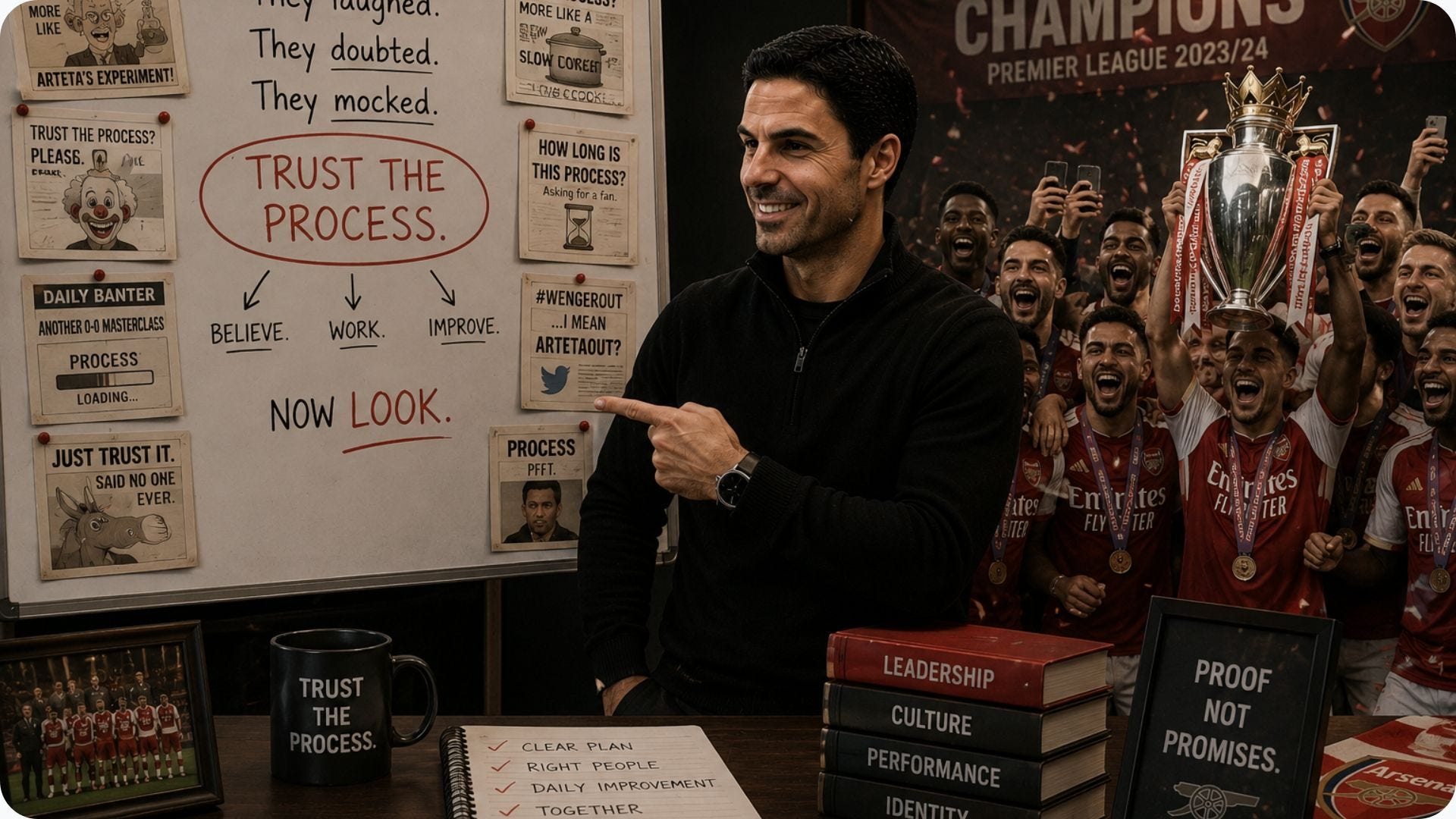
The core lesson
Every phase builds on the one before it. You can’t develop tactical maturity without first fixing the culture, and you can’t reach consistency without a tactical foundation. Skip a step and you’re building on sand. This isn’t just true at the elite level. It applies to every team, from grassroots to youth football.
The Right Order, and Why It Works (phases of play)
If development happens in steps, the question is: where do you start? There’s a clear logic taught in coaching education, and it has a solid reason. The defensive organisation is faster to establish than the attacking side, because it rests above all on mentality, organisation and discipline. Staying compact, shifting as a unit, protecting the central channel, all of that demands commitment and coordination far more than technical brilliance.
The attacking side of the game is the opposite: highly complex. Clean build-up play and possession under pressure require technical quality, split-second decision-making and the perfect interplay between many players. That’s why the natural way to build a team is from back to front: first stability without the ball, then transitions, and over the longest stretch of time the hardest of all, the in-possession game.
Why this is psychologically smart
A young or newly assembled team needs early wins. A solid defensive structure delivers exactly that: it keeps results tight and builds confidence. Coaches who go the opposite way and chase attractive possession football first risk heavy defeats and a loss of belief that stalls the whole development.
But, and this is the crucial point: in real life, you don’t spend a whole season training only the defensive side. That would be unrealistic and joyless. It’s not an either/or, it’s about focus. You put the main emphasis on one phase and keep the others ticking over. Here’s what that looks like in practice.
It’s never about one phase only. It’s about the right focus at the right time.
From Plan to Pitch: Yearly & Weekly Cycle
Theory is fine, but as a coach you want to know how this lands on the training pitch. So let’s look at two concrete tools: a rough yearly cycle with shifting focuses, and a typical training week that shows how to set a clear emphasis without letting the other phases drift.
The yearly cycle shifts the focus across the season but always builds on what came before. Crucial point: possession is trained from day one, it just doesn’t take centre stage until the foundation is in place.
Pre-season
Focus: Defensive Organisation
Compactness, defensive shape, shifting as a unit. Possession is trained in simple forms, but the main focus is on stability.
Season Start
Focus: Transitions
Quick transitions after winning the ball, and behaviour after losing it. The defensive base is now routine and only needs refreshing.
Autumn / Winter
Focus: Possession & Build-up
Now the most complex piece moves to centre stage: building from the back, ball retention under pressure. Defence and transitions are in place and carry the team.
Second Half
Focus: Fine-tuning & Match Scenarios
All phases get connected and sharpened against specific opponents and game situations. The team has mastered the foundation, now it’s about the details.
The training week shows the same principle on a smaller scale. Suppose the seasonal focus is currently on transitions. A typical week with a Sunday match looks something like this:
Monday
Day off / Recovery
Recovery from the weekend match.
Tuesday
Focus: Transition after winning the ball
The main theme of the week. Game forms with quick transitions, counter-attack drills, plenty of repetitions.
Wednesday
Possession (kept ticking over)
Rondos and positional games. Even when the weekly focus is elsewhere, possession is maintained consistently and never dropped entirely.
Thursday
Focus deepened + defensive refresh
Transitions in more complex game forms, combined with a short refresh of the defensive shape.
Friday
Opponent-specific prep
Specific match plan elements, set pieces, opponent-specific adjustments. All phases brought together.
Sunday
Matchday
The match is the most important test. What worked and what didn’t feeds straight into next week’s planning.
The principle behind both plans
A focus doesn’t mean dropping everything else. It means giving one phase the most training time and the most attention, while the others tick over with less. That way the team develops in one area on purpose, without losing ground in the others. That’s the difference between a thought-through plan and simply running through drills.
What you can take away as a coach
Think backwards from your end goal. Define where you want your team to be in a year, and plan the steps to get there, just like Arteta. End goal first, then the path.
Set a focus, don’t chase everything at once. One clear main focus per phase of the season, one main theme per training week. The other phases keep ticking over with smaller chunks, but never disappear entirely.
Build from back to front. Start with defence and transitions for quick stability, and give the complex in-possession game the time it needs. But train possession from day one, just with a smaller share at first.
Master one step before shifting the focus. Ask yourself honestly: does the current theme hold up under match pressure? Only then shift the emphasis.
Communicate the process. Explain to your players and the people around you that development takes time. Those who understand the plan stick with it through the rough patches.
👉New Module - Playing Principles
Maybe while reading this article you realised something: I’ve never actually written down my own playing principles. You have an idea in your head, a sense of how you want your team to play, but you’ve never cleanly articulated and recorded it.
You’re not alone. This is the single most common blind spot in grassroots and youth football. And it’s exactly where our new module comes in.
01
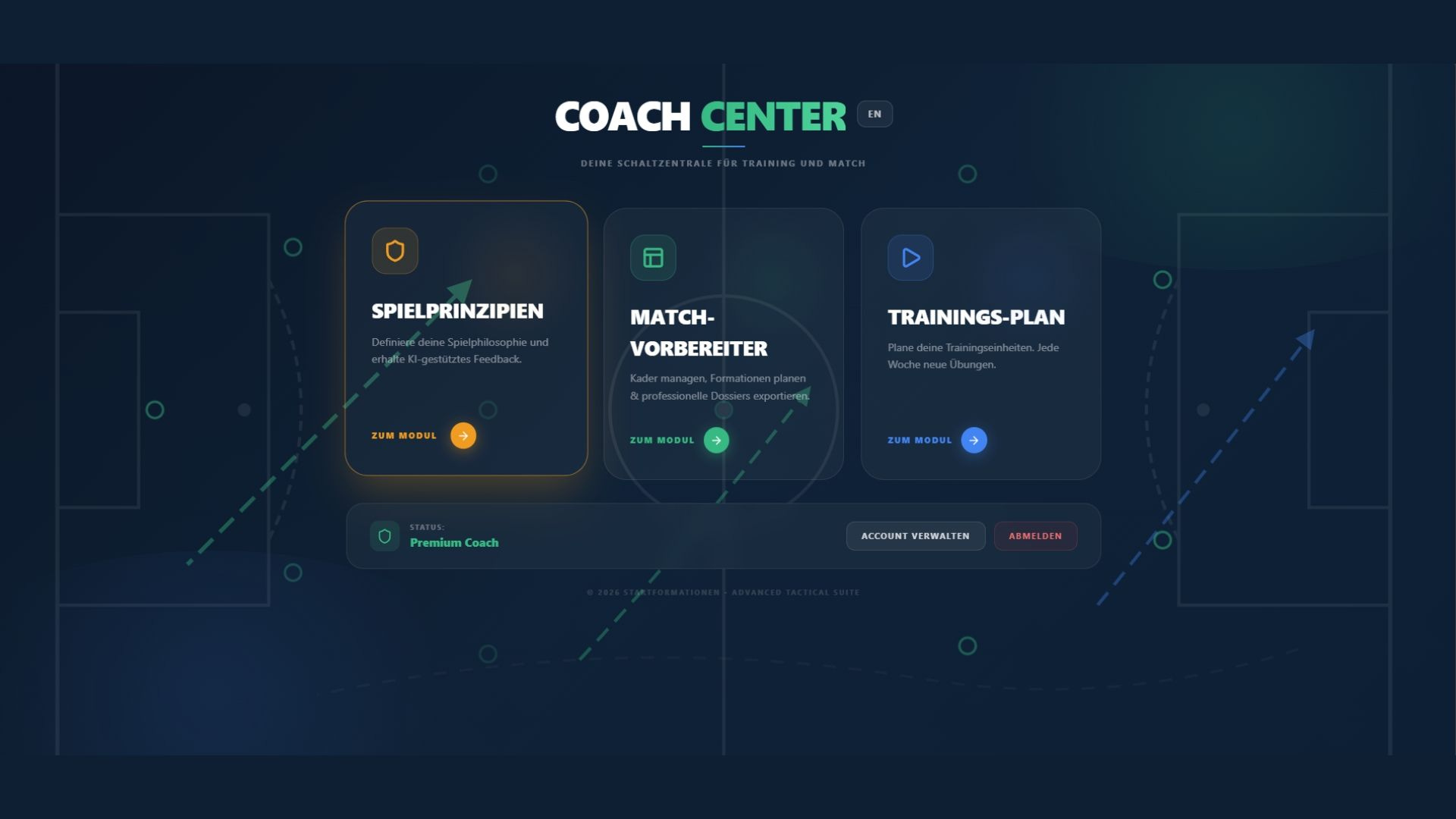
Playing Principles Builder New
Answer targeted questions across all four phases of play, and your AI assistant helps you cleanly define your own playing principles. At the end you get a clear, personal profile of your playing identity, which you save and use as your foundation throughout the season.
02
AI Guidance in the Match Planner New
You can now get advice on your next match directly via the AI button in the Match Planner. The AI draws on your saved playing principles and suggests a tactical approach for the specific opponent, always within the framework of your own playing identity.
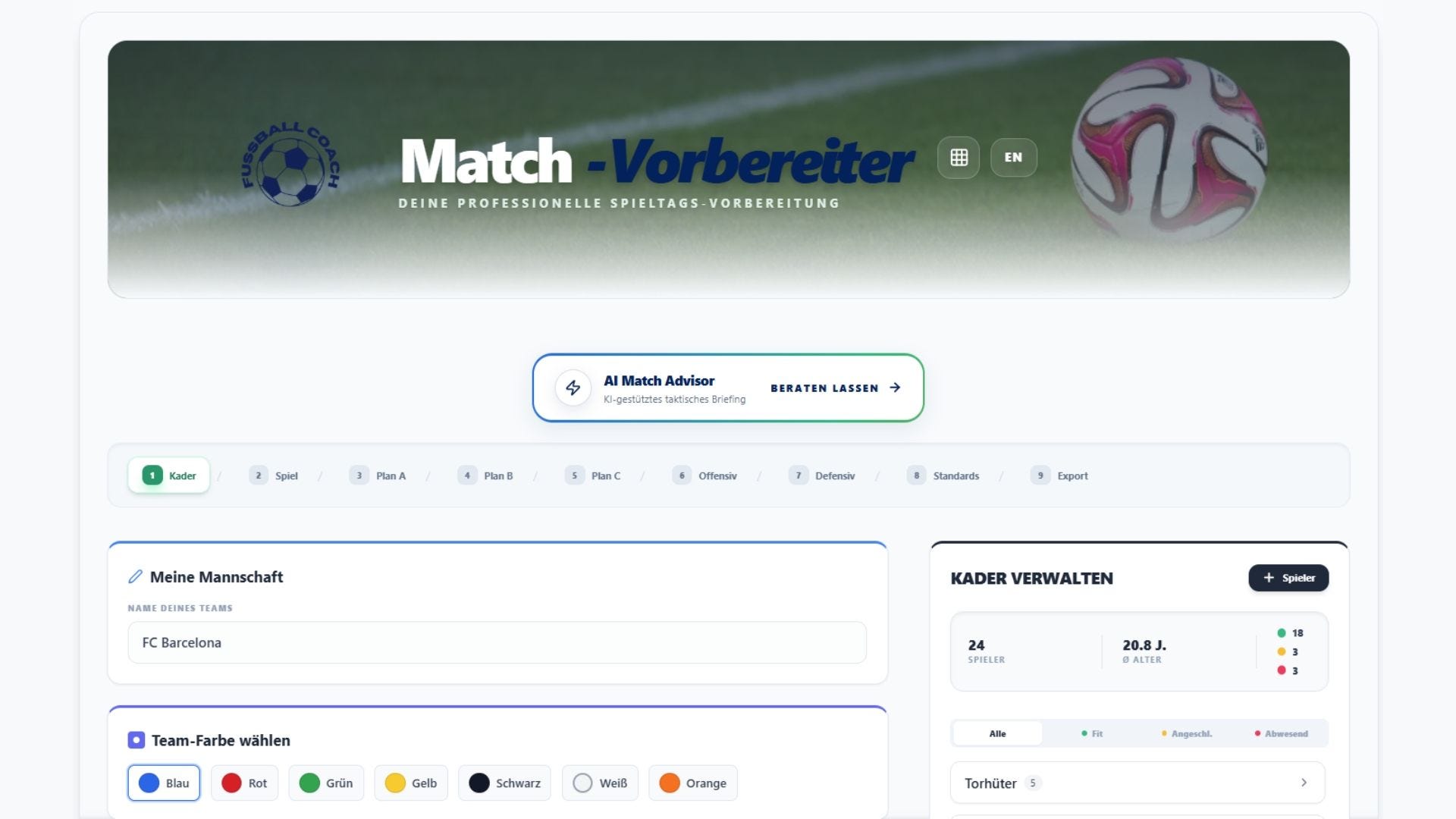
03
Match Planner & Session Planner
As always, you prepare your matches step by step and plan your training sessions with AI-generated drills. Now connected to your playing principles as a shared foundation.
How it all fits together
Once: define your principles
You answer the questions and set your playing principles. You do this once, and they stay your foundation for the season.
Every week: prepare the match
In the Match Planner you enter your opponent and your available players, exactly as before.
At the touch of a button: a tactical suggestion
Via the AI button you get a tactical suggestion based on your principles and the specific opponent. You make the final call in the end, the AI is your sparring partner, not your boss.
All three modules are included in your subscription, at the same price. Try the Playing Principles Builder and discover how much clarity a cleanly defined foundation brings to your work.
Great read hope you are looking forward to the season let’s connect here supporting you keep doing a great job